Boost acceptance rates
Last updated: August 4, 2026
Intelligent Acceptance is an optimization engine that manages your payment logic with a self-learning system. It uses multi-armed bandit algorithms to balance acceptance, cost, and fraud. Intelligent Acceptance runs multiple micro-decisions at the same time on live traffic.
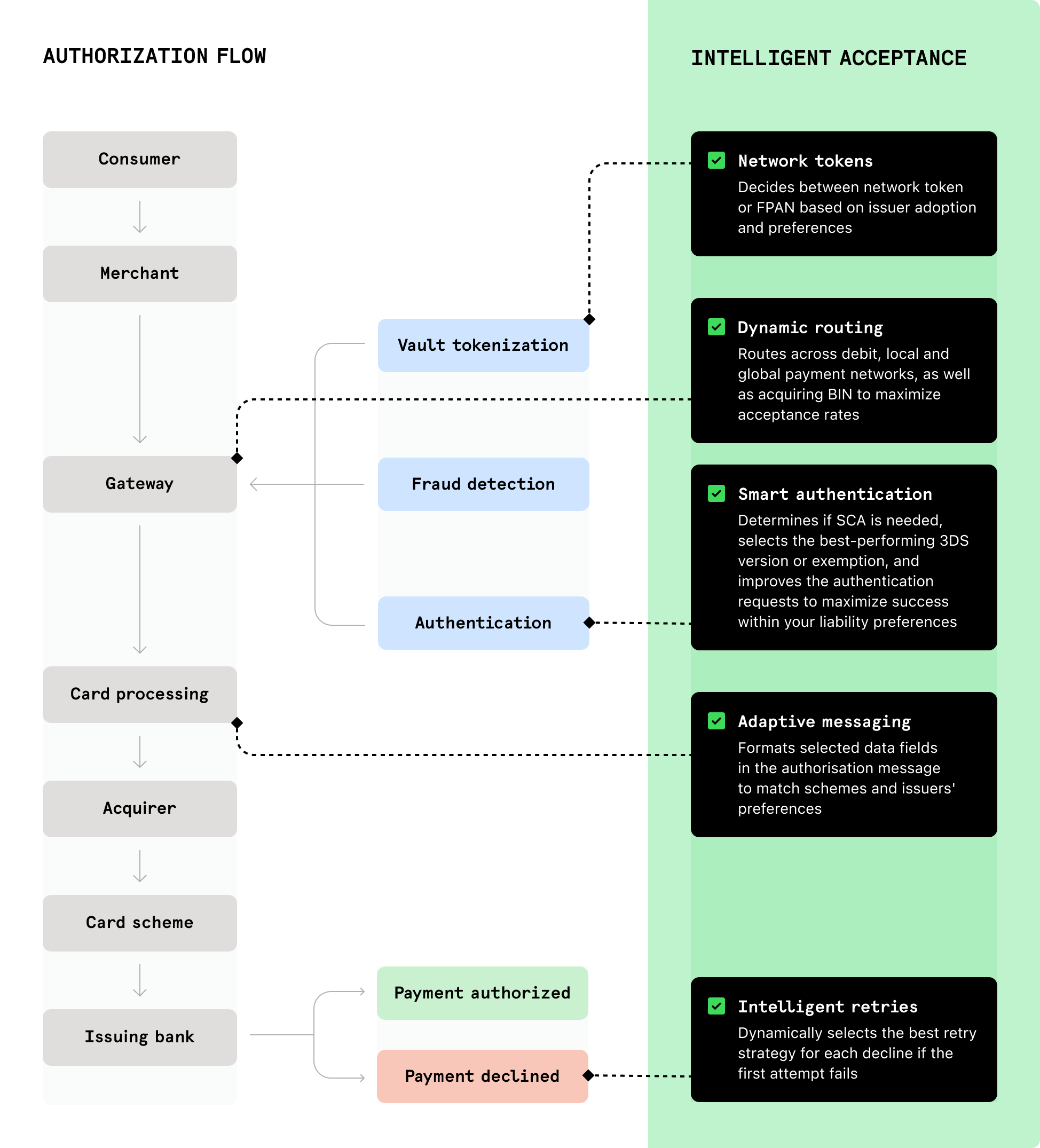
Intelligent Acceptance automates payment engineering across five optimization categories, so you do not need to build and maintain internal retry logic or static routing rules.
To enable Intelligent Acceptance, contact your account manager or request support.
Checkout.com applies optimizations across the following five categories during the authorization process.
To adapt payment messages to issuer preferences and scheme mandates, Intelligent Acceptance:
- Selects between authentication and authorization channels based on historical issuer performance.
- Applies 3D Secure (3DS) based on scheme mandates, regulations, your preferences, issuer and network preferences, and the transaction's risk profile.
- Uses the best-performing exemption type, such as a Transaction Risk Analysis (TRA) or low value exemption.
- Requests challenge or frictionless flows based on specific issuer preferences.
- Uses the 3DS protocol version with the highest chance of success.
Intelligent Acceptance evaluates live transaction-level context to decide when to use a network token instead of primary account number (PAN) credentials. It uses a network token if:
- The issuer supports network tokens.
- The chance of approval is higher than with PAN credentials.
- The predicted cost is lower.
It also optimizes token provisioning, choosing between synchronous and asynchronous based on the best projected outcome.
Intelligent Acceptance adapts fields in the payment request to match scheme and issuer preferences before we send the transaction.
For example, it formats strings such as billing addresses to match issuer preferences, so Address Verification System (AVS) checks pass successfully.
Intelligent Acceptance manages transaction routing to optimize for acceptance rate and processing cost:
- Network routing – Routes transactions through available debit, local, or global networks based on predicted acceptance rates and your configured business goals.
- Credential updates – Updates card details on the first attempt to prevent initial declines.
- Account Funding Transactions – Applies smart downgrades to Account Funding Transactions (AFTs) in accordance with mandates and issuer adoption.
When a transaction is declined, Intelligent Acceptance checks the decline response code and network signals, then automatically triggers a recovery attempt.
Intelligent Acceptance applies the following retry strategies:
- Technical declines – Corrects formatting errors based on issuer communication, and retries the request.
- Network retries – Retries the failed transaction on an alternative network.
- Strong Customer Authentication (SCA) soft declines – Retries using new authentication routes, or upgrades the transaction to present a 3DS challenge.
- Credential updates – Manages card expiry dates, or uses Real-Time Account Updater to refresh card details before the retry.
- Network token fallback – Retries using the original card credentials if an issuer fails to process a network token correctly.
Information
To use some retry strategies, you must have the relevant solutions integrated into your stack.
The Dashboard breaks down your Intelligent Acceptance performance metrics by attempt, so you can see the impact of our optimizations at every step of the transaction.
Checkout.com calculates your total boost using the following formula:
This metric measures the impact of the optimizations we apply before we send the transaction to the issuer.
To calculate it, we split your traffic into two comparable groups. We optimize most of your transactions, and keep a small portion of them unoptimized as a control group. We then compare the authorization rate (AR) of the two groups.
We apply a statistical check to confirm the reported AR difference is significant, and not due to random variance. This proves the increase in AR is attributable to Intelligent Acceptance.
This metric measures the exact volume of transactions we recover through intelligent retries alone.
These transactions were declined on the first attempt and approved thanks to our retry. This is direct impact attributable to Intelligent Acceptance, with no need for statistical estimation.
The Dashboard highlights the specific, measurable revenue that Intelligent Acceptance generates, rather than your general acceptance rates.
You can view your Intelligent Acceptance metrics in the Dashboard:
- Sign in to the Dashboard.
- Go to Payments > Analytics > Intelligent acceptance.
- Select the time frame you want to view metrics for.
The Dashboard displays the following metrics and data breakdowns:
| Metric | Description |
|---|---|
Revenue boost | The total incremental revenue Intelligent Acceptance generates. |
Transactions saved | The estimated number of transactions authorized because of Intelligent Acceptance, which would otherwise have failed. |
Total AR boost | The overall authorization rate uplift, calculated and displayed as the sum of the first attempt boost and the reattempts boost. |
Breakdown by attempt | Data that separates performance into first attempts and reattempts. |
First-attempt performance | A comparison of optimized traffic against the unoptimized control group. This includes the confidence checks we apply to validate the estimated boost. |
Retries performance | A detailed breakdown of retry volumes and exact success rates, categorized by the original issuer decline code. |
Breakdown by optimization | A chart of the uplift attributed to specific optimization categories, such as authentication management or intelligent retries. |
In addition to the aggregated data, you can get deeper insights from the Payment optimized webhook. It sends real-time event logs directly to your engineering environment, and records the optimization applied to each transaction.